
Thingiverse
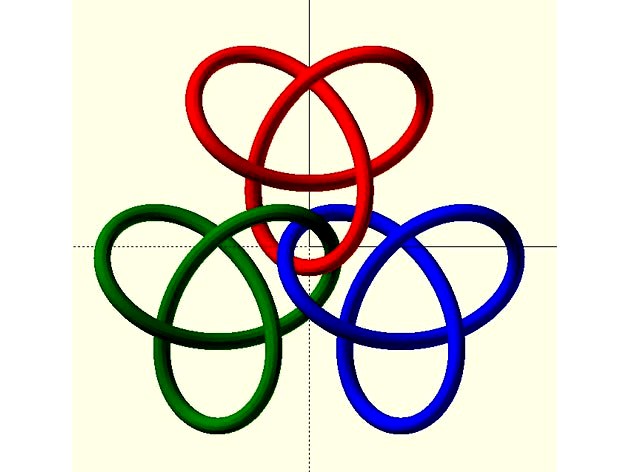
Three linked trefoils by kitwallace
by Thingiverse
Last crawled date: 4 years, 7 months ago
Revised 15/5/17
An OpenSCAD version of dennedesigns http://www.thingiverse.com/thing:1448630
The base OpenSCAD code is generated by my knot generatorhttp://kitwallace.co.uk/3d/knot.xq
using the fourier function but replacing the last lines with
path = Paths[0];
knot= path_knot(path,R,Sides,Kscale);
d=2.5;
r=30; // configuration 1
// r=90; // configuration 2
echo(r);
for (k=[0:2]) {
scale(Scale)
color(colours[k])
translate([d * cos (k*120), d * sin(k*120),0])
rotate([0,0,r])
show_solid(knot);
}
This generates the two configurations shown.
At first glance the result looks like Borromean rings with trefoils in place of unknots. However cutting any single knot leaves the other two still joined, so this is not a Brunnian link. It would be nice to make a Borromean version.
An OpenSCAD version of dennedesigns http://www.thingiverse.com/thing:1448630
The base OpenSCAD code is generated by my knot generatorhttp://kitwallace.co.uk/3d/knot.xq
using the fourier function but replacing the last lines with
path = Paths[0];
knot= path_knot(path,R,Sides,Kscale);
d=2.5;
r=30; // configuration 1
// r=90; // configuration 2
echo(r);
for (k=[0:2]) {
scale(Scale)
color(colours[k])
translate([d * cos (k*120), d * sin(k*120),0])
rotate([0,0,r])
show_solid(knot);
}
This generates the two configurations shown.
At first glance the result looks like Borromean rings with trefoils in place of unknots. However cutting any single knot leaves the other two still joined, so this is not a Brunnian link. It would be nice to make a Borromean version.