
Thingiverse
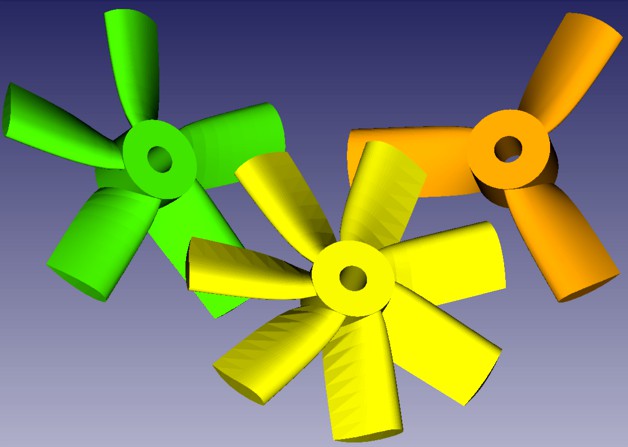
Propeller factory using UIUC Airfoil Coordinates database by Johann_LA
by Thingiverse
Last crawled date: 4 years, 11 months ago
This is a universal propeller factory which makes use of the UIUC Airfoil Coordinates database which can be found at https://m-selig.ae.illinois.edu/ads/coord_database.html
To utilize an airfoil profile from that database you need to extract it with the included airfoil perl scripts. For the scripts you need:
perl (programming / scripting language)
libwww-perl
perl-LWP-Protocol-https
In a Windows environment I'm using Cygwin for this which you get from http://www.cygwin.org -- other option would be to use active perl.
You invoke the script by
perl airfoil_FORMAT.pl URL
where
FORMAT is either Selig or Lednicer (for a description of the different formats see https://m-selig.ae.illinois.edu/ads.html section airfoil format)
URL is the url with the airfoil dat file
When the airfoil script has done it's job, a foil.scad file has been generated and you can start the propeller OpenSCAD file (assuming that foil.scad generated by the script above is in the same directory).
For your convenience I add a demo profile / foil.scad file.
For the picture I've taken a ClarkY and an Eppler 625 airfoil.
Please follow these easy steps to get the STL files you want:
install openSCAD: https://www.openscad.org (it is free of charge)
open the propeller.scad file of this thing (a foil.scad file has to be in the same directory)
adjust the parameters as you like (inner diameter, outer diameter, etc.)
render the design by pressing F6
export to STL by pressing F7
Note: OpenSCAD is mandatory, the Thingiverse Customizer won't work (at least not in the current version).
Note: some airfoils from the above mentioned database are in the Selig format, others in Lednicer format. If you look into the dat file and see in line two some numbers bigger than 1 you want to use airfoil_Lednicer.pl, otherwise you use airfoil_Selig.pl.
Johann Schuster, August 2020
v 0.01: initial revision
v 0.02: fixed a bug with missing propeller diameter in the customizer
v 0.03: added option to include a spinner
v 0.04: added another variant of a spinner which looks better for large exponents (called spinner power in the design)
To utilize an airfoil profile from that database you need to extract it with the included airfoil perl scripts. For the scripts you need:
perl (programming / scripting language)
libwww-perl
perl-LWP-Protocol-https
In a Windows environment I'm using Cygwin for this which you get from http://www.cygwin.org -- other option would be to use active perl.
You invoke the script by
perl airfoil_FORMAT.pl URL
where
FORMAT is either Selig or Lednicer (for a description of the different formats see https://m-selig.ae.illinois.edu/ads.html section airfoil format)
URL is the url with the airfoil dat file
When the airfoil script has done it's job, a foil.scad file has been generated and you can start the propeller OpenSCAD file (assuming that foil.scad generated by the script above is in the same directory).
For your convenience I add a demo profile / foil.scad file.
For the picture I've taken a ClarkY and an Eppler 625 airfoil.
Please follow these easy steps to get the STL files you want:
install openSCAD: https://www.openscad.org (it is free of charge)
open the propeller.scad file of this thing (a foil.scad file has to be in the same directory)
adjust the parameters as you like (inner diameter, outer diameter, etc.)
render the design by pressing F6
export to STL by pressing F7
Note: OpenSCAD is mandatory, the Thingiverse Customizer won't work (at least not in the current version).
Note: some airfoils from the above mentioned database are in the Selig format, others in Lednicer format. If you look into the dat file and see in line two some numbers bigger than 1 you want to use airfoil_Lednicer.pl, otherwise you use airfoil_Selig.pl.
Johann Schuster, August 2020
v 0.01: initial revision
v 0.02: fixed a bug with missing propeller diameter in the customizer
v 0.03: added option to include a spinner
v 0.04: added another variant of a spinner which looks better for large exponents (called spinner power in the design)