
Thingiverse
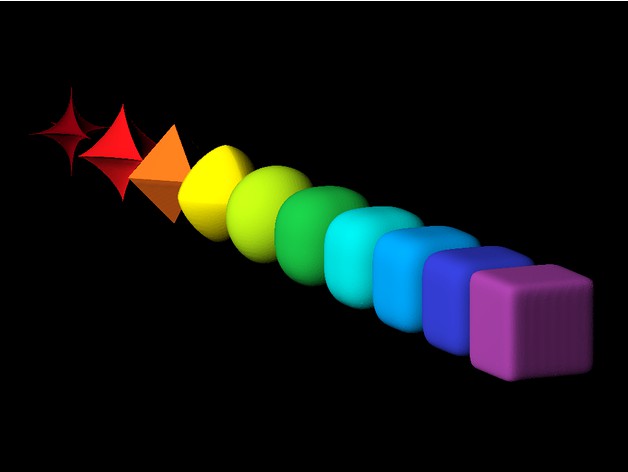
Non Euclidean Lp spheres by tato_713
by Thingiverse
Last crawled date: 4 years, 6 months ago
Of course, "non-Euclidean space" is any space that doesn't follows the Euclidean metrics, but I was bored and wondered how a sphere should look like using a different Lp distance. I made a simple script on MATLAB R2020a to graph them on 10cm "spheres". The "normal" distance we know in a Cartesian coordinates system is the L2, the "real" distance, that, in R2 dimension, it follows the Pythagoras Theorem. A sphere is a surface in R3, in which each point has the same distance to its centroid. Having that in mind, I chance that "distance", from norm 2 to other norm indexes:
L0.5: Every p index lower than 1 (0 < p < 1), actually does not define a norm, or at least a norm with homogeneous function.
L0.75
L1: The infamous Manhattan distance, or Taxicab distance. Is the distance result of the direct sum of the coordinates, as if it were driving in a square grid of streets. The resulting sphere is a regular octahedron.
L1.5
L2: The Euclidean distance, or Pythagorean distance, the metric we normally use. The resulting sphere is a sphere (duh).
L2.5
L3
L4
L5
L10: As you may notice from the sequence to this point, while bigger the index, more cube alike the sphere turns. Of course, an L∞ should be a plain cube, but, beyond this point, my computer takes days generating these geometries running my script.
My knowledge about these maths is limited, if you want to learn more about these metrics, go and look at other sources. Wikipedia is good enough for this.References
Surf to STL function for MATLAB
I spend part of my time making these models, letting them available and free for everyone. If you want to support my work, you can contribute with me here:
L0.5: Every p index lower than 1 (0 < p < 1), actually does not define a norm, or at least a norm with homogeneous function.
L0.75
L1: The infamous Manhattan distance, or Taxicab distance. Is the distance result of the direct sum of the coordinates, as if it were driving in a square grid of streets. The resulting sphere is a regular octahedron.
L1.5
L2: The Euclidean distance, or Pythagorean distance, the metric we normally use. The resulting sphere is a sphere (duh).
L2.5
L3
L4
L5
L10: As you may notice from the sequence to this point, while bigger the index, more cube alike the sphere turns. Of course, an L∞ should be a plain cube, but, beyond this point, my computer takes days generating these geometries running my script.
My knowledge about these maths is limited, if you want to learn more about these metrics, go and look at other sources. Wikipedia is good enough for this.References
Surf to STL function for MATLAB
I spend part of my time making these models, letting them available and free for everyone. If you want to support my work, you can contribute with me here: