
Thingiverse
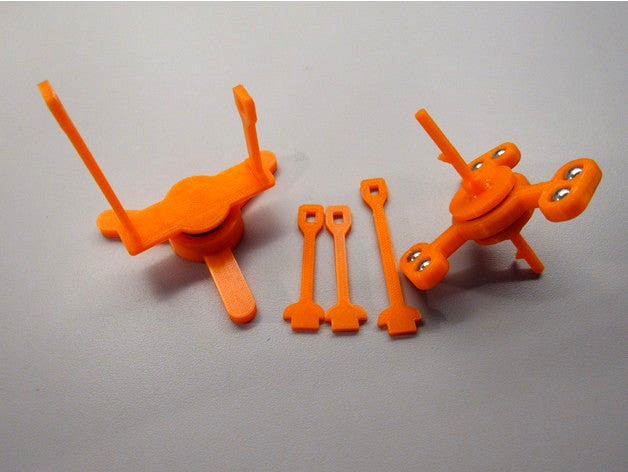
Fidget Spinner Science - Conservation of Angular Momentum by khackbarth
by Thingiverse
Last crawled date: 4 years, 12 months ago
This project is an extension of a fidget spinner modeling and printing lesson that I did with my class and is described at:https://www.thingiverse.com/thing:2338377
I got the idea for this fidget spinner-based experiment after remembering the gyroscopic precession demonstrations in college using a custom bicycle wheel as shown in this video:https://www.youtube.com/watch?v=UZlW1a63KZs&feature=youtu.be&t=45s
Though the video is labeled Conservation of Angular Momentum, that is not directly evident from the video. I thought it might be possible to show conservation by showing that as the person/rig supporting the spinner spun faster and faster (by increasing the angle of the spinner axle) the spinner itself would spin for a shorter length of time. I also had a lot of fun designing the rig to mount the spinner and provide an additional rotational element (which had to get its momentum from the spinner).
The included video shows how the rig is constructed and how the experiment is performed. I've also attached a data sheet and presentation that I used with my students. The key to good data is consistency in the force of the spin, not introducing additional forces on the rotor, when the rotor is released and when the stopwatch is started.
As I say in the presentation, the rig is not unbreakable. In particular, the support arms can be broken more easily than the other components simply because of their orientation on the build plate. So students should refrain from "smacking" the spinner to get it started. Be gentle!
Students use a stopwatch to time the length of spin of the spinner with different post length configurations. The greater the difference in the height of the posts the faster the rotor should spin and the shorter amount of time that the spinner should spin - I hope!
I got the idea for this fidget spinner-based experiment after remembering the gyroscopic precession demonstrations in college using a custom bicycle wheel as shown in this video:https://www.youtube.com/watch?v=UZlW1a63KZs&feature=youtu.be&t=45s
Though the video is labeled Conservation of Angular Momentum, that is not directly evident from the video. I thought it might be possible to show conservation by showing that as the person/rig supporting the spinner spun faster and faster (by increasing the angle of the spinner axle) the spinner itself would spin for a shorter length of time. I also had a lot of fun designing the rig to mount the spinner and provide an additional rotational element (which had to get its momentum from the spinner).
The included video shows how the rig is constructed and how the experiment is performed. I've also attached a data sheet and presentation that I used with my students. The key to good data is consistency in the force of the spin, not introducing additional forces on the rotor, when the rotor is released and when the stopwatch is started.
As I say in the presentation, the rig is not unbreakable. In particular, the support arms can be broken more easily than the other components simply because of their orientation on the build plate. So students should refrain from "smacking" the spinner to get it started. Be gentle!
Students use a stopwatch to time the length of spin of the spinner with different post length configurations. The greater the difference in the height of the posts the faster the rotor should spin and the shorter amount of time that the spinner should spin - I hope!