
Thingiverse
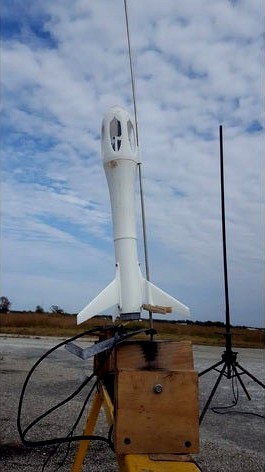
Bubble, 3D printed model rocket by julienleclerc
by Thingiverse
Last crawled date: 4 years, 7 months ago
Detailed instructions are available on Instructables: https://www.instructables.com/id/Bubble-3D-Printed-Model-Rocket
I was searching for a reusable 3D printed model rocket that could carry a camera to take aerial videos. Unfortunately, I could not find such a design. I, therefore, decided to design my own rocket and share it with the world!
Several iterations were needed to obtain a model that is stable and that possess a reliable parachute deployment system. I wanted to make something pretty and sometimes good-looking features were privileged over performance.
Bubble possesses several features unavailable on other 3D printed model rocket designs (at the time this article is written):
_The motor is thermally insulated from the 3D printed body of the rocket. PLA is the most common and easiest material to print but it melts at low temperatures (60C). Rocket motors can become quite hot and this thermal insulation allows keeping the 3D printed parts under this value.
_The fins have an airfoil shape. This reduces the rocket drag and improves stability.
_A large payload bay allows the user to attach a camera and/or an altimeter.
In addition, the geometry is optimized for 3D printing. It is easy to print and does not necessitate supports.
Bubble is designed to be flown with an Estes D12-3 motor (packs of two motors available for less than $11) and launched using a 3/16'' rod. The rocket flies successfully and reaches an altitude of approximately 230 meters. It was launched 5ft long rod.
I was searching for a reusable 3D printed model rocket that could carry a camera to take aerial videos. Unfortunately, I could not find such a design. I, therefore, decided to design my own rocket and share it with the world!
Several iterations were needed to obtain a model that is stable and that possess a reliable parachute deployment system. I wanted to make something pretty and sometimes good-looking features were privileged over performance.
Bubble possesses several features unavailable on other 3D printed model rocket designs (at the time this article is written):
_The motor is thermally insulated from the 3D printed body of the rocket. PLA is the most common and easiest material to print but it melts at low temperatures (60C). Rocket motors can become quite hot and this thermal insulation allows keeping the 3D printed parts under this value.
_The fins have an airfoil shape. This reduces the rocket drag and improves stability.
_A large payload bay allows the user to attach a camera and/or an altimeter.
In addition, the geometry is optimized for 3D printing. It is easy to print and does not necessitate supports.
Bubble is designed to be flown with an Estes D12-3 motor (packs of two motors available for less than $11) and launched using a 3/16'' rod. The rocket flies successfully and reaches an altitude of approximately 230 meters. It was launched 5ft long rod.